Eyes versus scope
Added 2026-09-12. The console's composite video now goes two ways at
once: to the scope, whose record is what the family's own decoder works
from, and to a USB frame grabber on the bench's Raspberry Pi, a TV
chip's own opinion of the same signal. tools/eyes.py takes both
together and scores the two pictures on the console's pixel grid. This
page is the setup, the pictures, and what the first comparison said.
The setup
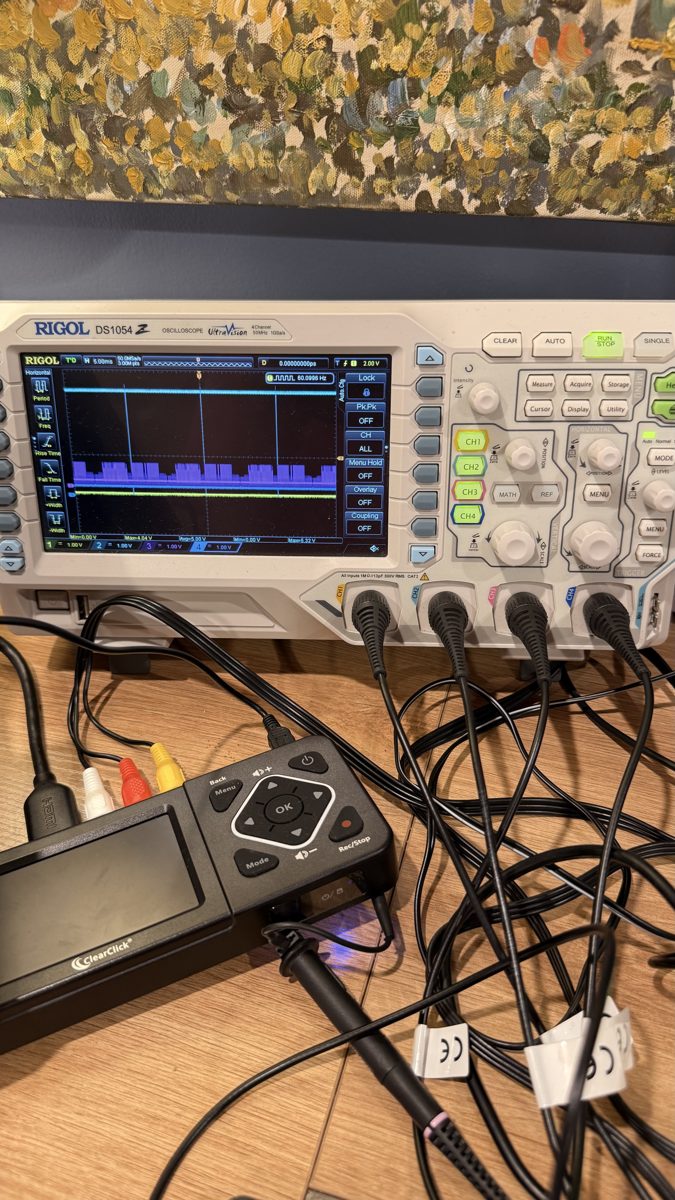
- The console, an NES-001, on the game that was in it (Super Mario Bros. and Duck Hunt on one cartridge), composite out at the RCA jack.
- A T at that jack. One leg to the scope's CH3 (DC, 200 mV/div, 1x probe: the channel ntsc-crt's own captures were scored on), the other to the grabber's yellow input. The 75 ohm load sits on whichever end is terminated, so the scope's input is as it was when those captures were scored.
- The grabber: a Roxio Video Capture USB stick on the Pi (its stable
name under
/dev/v4l/by-id; it was/dev/video2until a camera took the low numbers) through a driver built for it (below). Composite in, 720 by 480 frames out, in colour. - The scope: a Rigol DS1054Z on the bench LAN, 12 million points at 50 MSa/s, 240 ms, about fourteen frames per record. The tool saves its whole setup before touching it and restores it afterwards, so the other experiment on the same scope is never disturbed.
- The Pi holds the grabber and the camera and answers to the workstation over ssh; the workstation holds the decoder, the tool and the record.
The grabber, and how it came to work
The stick is an Empia chip marked EM2980 that reports chip id 146,
which no Linux kernel knew. The stock driver logs unknown em28xx chip ID (146) and registers only the stick's audio half; a 2014 kernel-list
thread worked out that its firmware implies a Conexant-class decoder
integrated on the chip and stopped there, and an Arch forum post
concluded nobody ever would get it going.
What changed since is that mainline Linux gained, in 2026, the EM2828X family with exactly such a built-in decoder, driven through the bridge's own registers, for the new Hauppauge USB Live2. The EM2980 is that family one number over. So the bench's driver is mainline em28xx built out of tree against the Pi's 6.12 kernel, with a patch: two shims so 7.x source builds on 6.12, the chip id, a board entry with the built-in decoder and the USB id, and bulk transfer by default, because the stick's isochronous endpoint delivers only the top sixth of each frame at any setting.
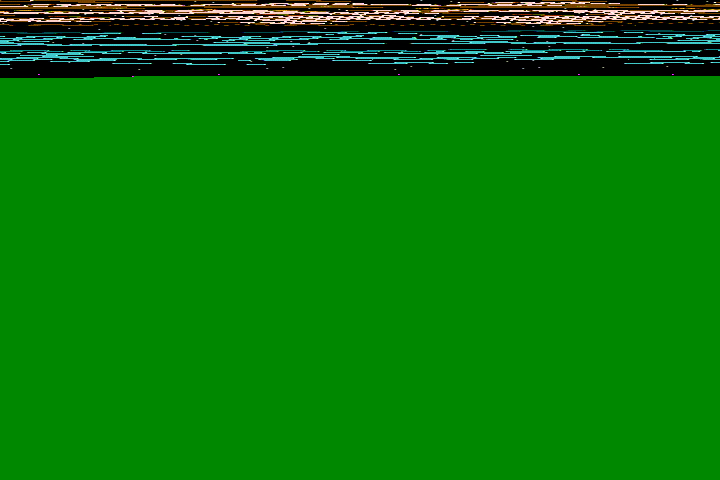
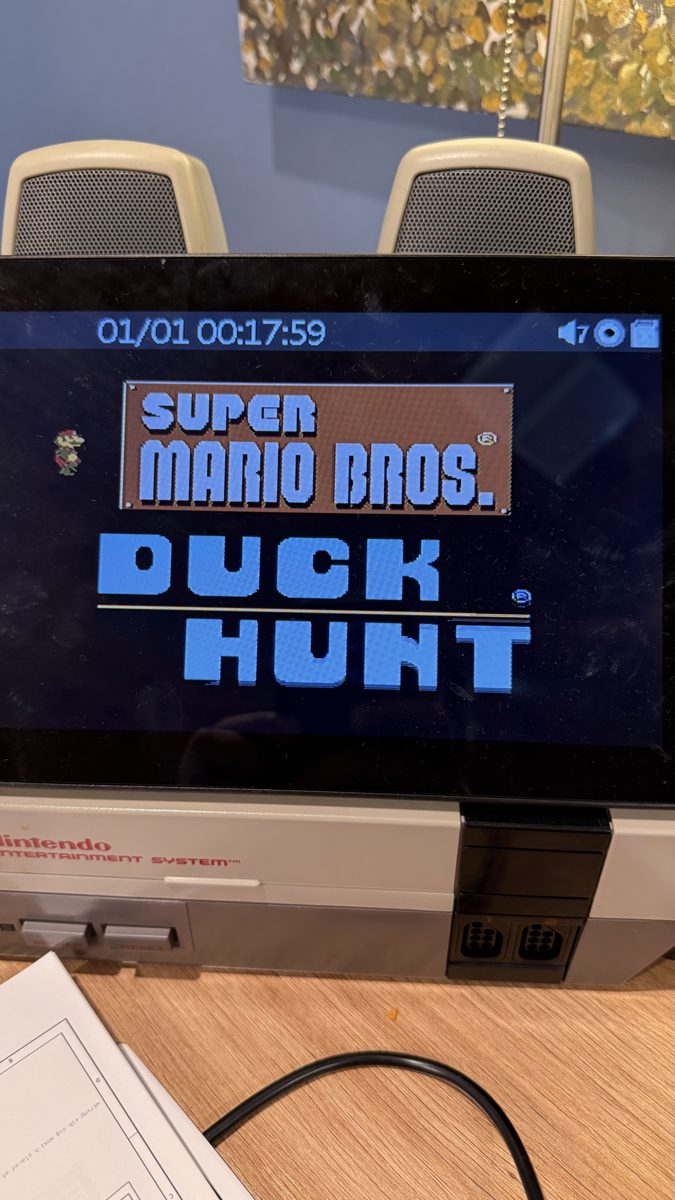
Bulk delivers the picture. The first thing it showed was the cartridge's title screen, which the TV beside the console was showing at the same time:

One evening went into a limit that was not one. The driver seemed to
deliver 400 of 480 lines, and every register the decoder's setup writes
was tried in turn to no effect. The cause was the driver's answer to
the "which standard did you detect" query: the built-in decoder cannot
detect one, the stock code answered "all of them", and the capture
tool fed that answer straight back as the standard to use. A mask with
the 625-line bit in it made the driver program 576-line geometry with
a 480 over 576 vertical scaler, and each 240-line field arrived as 200.
ffmpeg never asks, so it always got whole frames, which is how the
difference showed: the two programs' ioctls, traced side by side. The
driver now answers with the standard in force, and both stream whole
frames. The patch, a pinned build script and the full account are in
the repository under head/roxio-em28xx/.
The test
python3 tools/eyes.py pair --scope <ip> --pi <host> <name>   # both captures, together
python3 tools/eyes.py compare <name>                          # decode, align, score
pair sets the scope up as ntsc-crt's capture tool does, asks the Pi
for eight grabber frames through ffmpeg, and stops the scope the moment
they are in; on the run below the stop landed within a millisecond of
the last frame, so the record's last 240 ms and the frames are the same
picture. compare decodes the record with recover-real --nes (the NES
profile, the transcribed table's own levels), takes the grabber's first
field (the console is 240p, so every field is the whole picture), puts
both on the console's 256 by 240 grid, and finds the grabber's
horizontal window and vertical offset by luma correlation rather than
by assumption. It reports the mean absolute difference, the agreement
of flat blocks (where chroma filtering at edges cannot count), the hue
difference on saturated pixels, and the ten flat blocks that disagree
most, by console coordinates, and writes the three-panel picture and a
JSON beside the captures. captures/ is ignored by git; the pictures
here are copies.
What the first synchronized pair said (MEASURED 2026-09-12)
Super Mario Bros. world 1-1, the console idle.
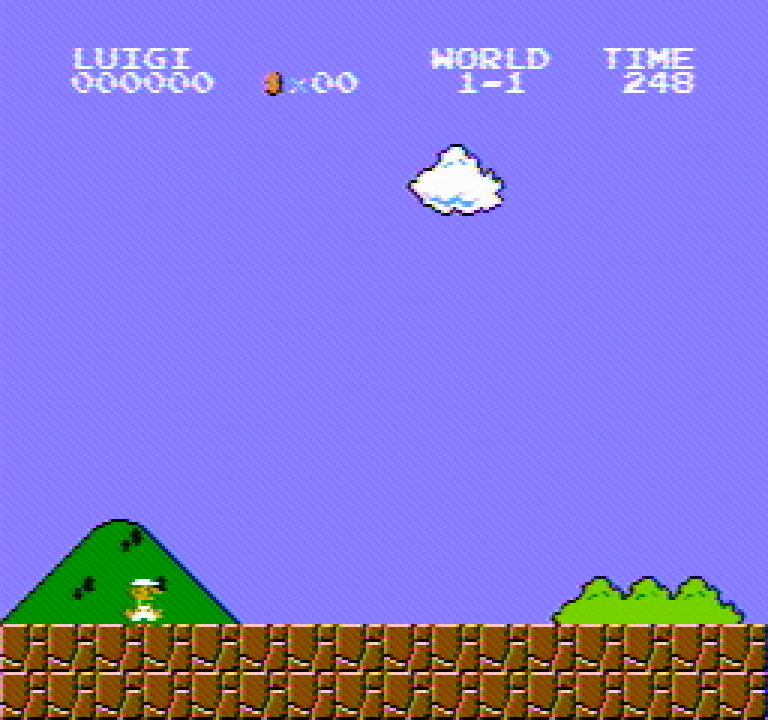
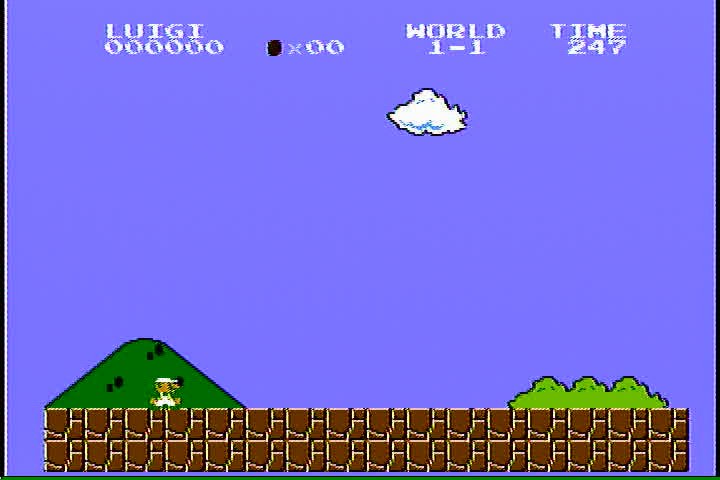
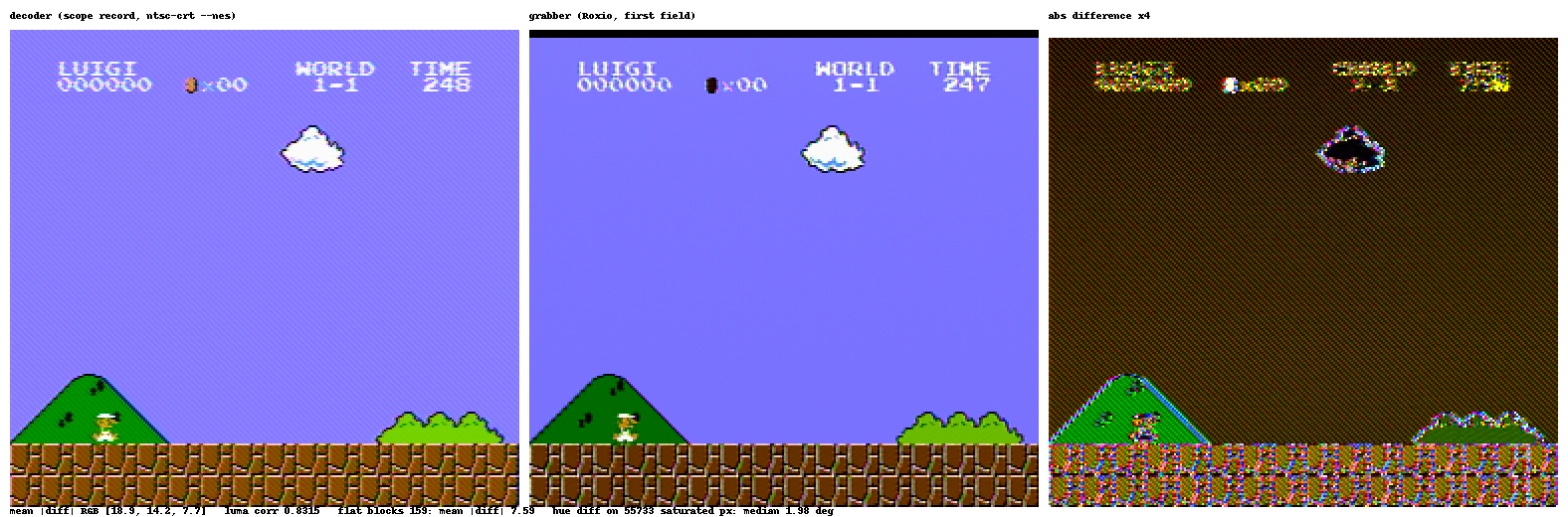
The decoder recovered the record at a rate error of -3.5 ppm with a worst burst residual of 0.17 grid samples. The grabber's console pixel 0 sits at sample 44 of its 720, four rows lower than the decoder's frame; the correlations that found that are 0.95 horizontally and 0.996 vertically, so the alignment is not in doubt.
| value | |
|---|---|
| flat blocks, of 240 | 159 flat; mean absolute difference 7.6 of 255 |
| hue, grabber minus decoder, on 55,733 saturated pixels | median +2.0 degrees |
| saturation, grabber over decoder | 1.05 |
| whole picture, mean absolute difference R, G, B | 18.9, 14.2, 7.7 |
The worst flat blocks are all sky: the decoder reads it as (137, 125, 255), the grabber as (121, 114, 255). Blue is clipped in both and the grabber sits about fifteen lower in red and green, uniformly across the picture: a black level or contrast setting in the Roxio's chip, not a hue error. Hue agrees to two degrees and saturation to five percent, which is the figure the picture work cared about; the decoder's hue is not the odd one out.
The whole-picture difference is edges. The grabber's chroma is 4:2:2 through a filter that is not the decoder's, so every vertical edge carries a halo in the difference panel. That is why the flat-block figure is the one to read, and why a running game is the wrong subject: a second's motion between two captures looks exactly like a decoding disagreement.
What this is for: the grabber is a second opinion on the same signal. Where the two agree, both are probably right. Where they differ on a flat colour, the JSON names the colour and the block, and the question goes to the console with a probe rather than to either decoder.
Three ways, with the cartridge in the model (MEASURED 2026-09-12, title1)
The cartridge came off the reader the same day (card-plan.md; the
dump's checksum is the database's own, D26EFD78), and the console
gained its board, mapper 66, so the model could run the same bytes.
eyes.py compare title1 --model <the dump> --frames 180 renders the
model's title screen through the same decoder chain as the scope
record and scores it against both eyes.
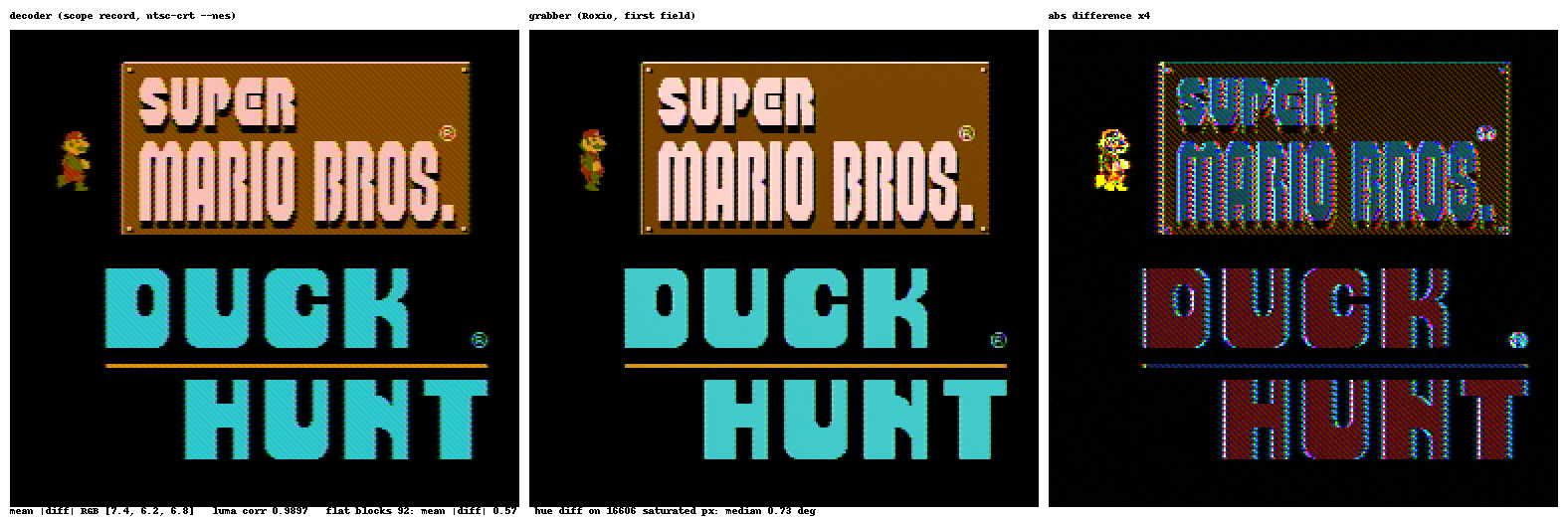
The two eyes first, on the title: flat blocks agree to 0.57 of 255, hue to 0.7 degrees median on 16,606 saturated pixels, saturation within 6 percent, luma correlation 0.99. That is the grabber's calibration, and it is tighter than the moving game gave.
Then the model against each:
| flat blocks, mean abs difference | hue median, saturated pixels | luma correlation | |
|---|---|---|---|
| model against decoder | 0.67 of 255 | 12.6 degrees | 0.95 |
| model against grabber | 1.26 of 255 | 14.1 degrees | 0.95 |
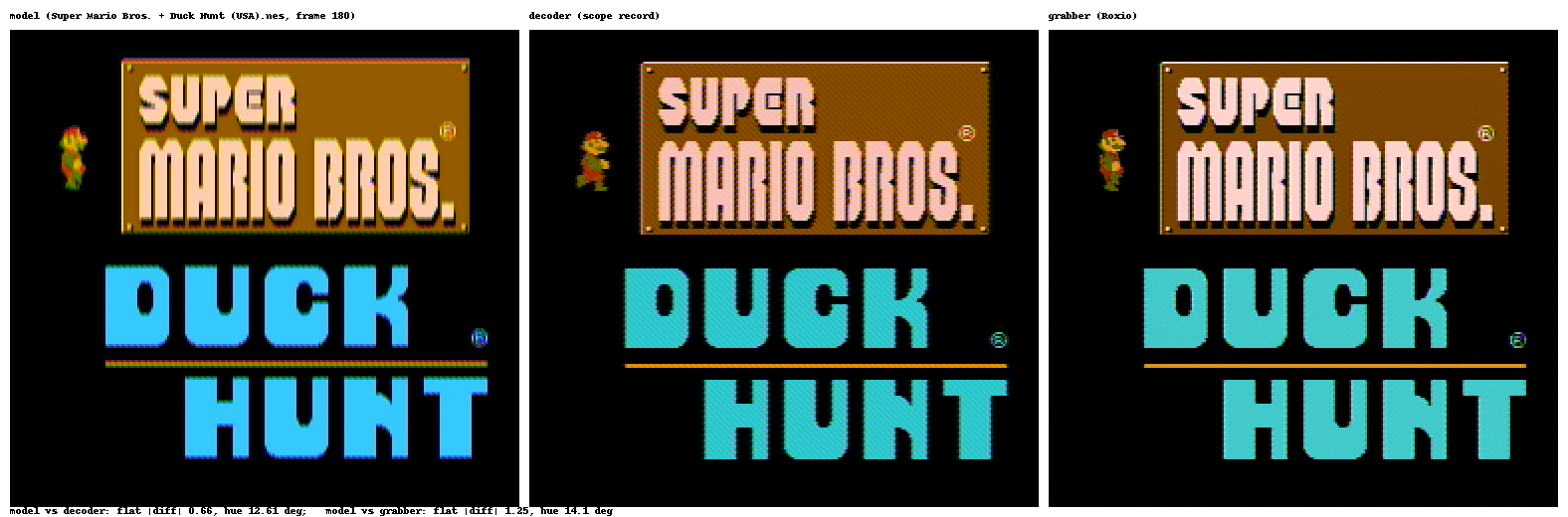
The flat blocks agree, because most of a title screen is black. The hue does not. The logo's brown is (148, 92, 0) in the model, (132, 73, 0) off the scope and (121, 69, 0) off the grabber; the lettering's cyan is (59, 200, 251) in the model against (45, 200, 205) and (67, 202, 202). Where the two eyes, two different decoders on the one signal, agree to a degree, the model sits twelve to fourteen degrees away on the same colours: bluer in the cyan, warmer in the brown.
RERUN 2026-09-13, on the model with its CPU and its sprite DMA corrected (the cartridge page tells that story): the same command, the same captures. Model against decoder flat blocks 0.66 of 255, hue median 12.61 degrees, luma correlation 0.95; model against grabber 1.25 of 255, 14.1 degrees, 0.95. The same numbers to the second decimal, so the hue is not the CPU's and not the DMA's. What changed is the frame itself: the small sprite the first run showed on the underline, which neither eye had at its instant, is gone (it was the stale sprite page the DMA copied), and the animated figure stands where the console's does. The three-panel picture above is the rerun's.
So the odd one out is the model's side of the picture chain, not the console and not either eye. The picture work (N6) had recorded hue misses on a synthetic roundtrip and attributed them to the card model's filter; this is the first time the part itself has been on the other side of the comparison, and it says the same thing about the model's hue with two witnesses. What it does not say yet is where in the chain: the encoder's palette phase, the burst phase the model synthesises, or the decoder's reading of its own synthesis. That is the next question, and it now has a measurement to be answered against.
Where the hue lives (MEASURED 2026-09-13)
The question the three-way left open was which stage of the model's picture chain owes the twelve to fourteen degrees. The answer came from measuring the same colour at two stages, then asking the die, then asking a second record of the same screen.
The signal stage, not the decoder. hue-stage (in the ntsc-crt
repository, crates/ntsc-source-cap/examples/hue-stage.rs) takes a
flat region of a real capture and the same colour through the encoder
and measures both twice: the chroma phase against the burst, projected
straight off the composite samples with no decoder in the way, and the
hue through the one decoder. On title1 the logo's brown ($17) differs
by 1.8 degrees at the signal and 3.1 through the decoder; the
lettering's cyan ($2c) by 14.4 at the signal and 15.2 through the
decoder. The decoder adds nothing: whatever it is, it is already in the
signal.
Not the die, and not the table. The switch-level 2C02's DAC gate had
held the transcribed level table sample for sample, but the standard
world's palette carries hues 1, 2, 4, 6, 7, 8 and 10: the die had never
been shown a hue-12 pixel. A world of one colour for each hue 1 to 12
at luma 2 (every_hue_speaks_the_transcribed_table in the 2c02
repository, crates/v2c02-dots/tests/dac.rs) puts every hue in front of
the DAC: zero mismatches on 7,680 samples for each, hue 12's wave on
the die 111111000000, the table's 111111000000. The digital chain
of the model is the die's.
Not hue 12 either. The same menu screen recorded on 2026-09-02
(smbdh-a, 125 MSa/s, the scope alone on the output) puts the cyan at
4.2 degrees from the table and the brown at 4.2, one constant; the SMB
title record puts its sky ($22) at 1.1 and its logo at 0.9; Duck Hunt's
sky ($21) at 3.5 and its grass ($29) at 2.4. Every hue measured on the
part sits within about four degrees of the table, except the cyan of
the title1 record, and there the brown sits at two.
The part's output under load. Folding the real waves by subcarrier
phase shows what the model's square waves are not: on the part, the
rise takes about six phases and the fall about three, the low level
sits a tenth of a volt under the table's, and the cyan's plateau at
1.05 V is rounded where the brown's at 0.80 V is not. That is the
2C02's known differential phase distortion (nesdev, "NTSC video"): the
PPU's output impedance depends on the level, the board's capacitance
slows the higher edges, and the effective hue rotates with the
voltage, brighter colours more. The wiki models it as an RC lowpass
whose time constant follows the voltage; applied to the model's waves
it rotates row 2 by 14.7 degrees at its amount 4 (the cyan's 14.4),
but row 1 by 7.5 where the brown measured 1.8, and it rotates every hue
of a row alike, as the measurements do. What the title1 session had
that the earlier records did not is the grabber on the same output as
the probe: a different load on the part's output stage, a stronger and
more nonlinear slew than one constant fits.
So the stage is the part's analogue output under the load of the eyes session, downstream of the DAC, which the model does not have at all; the decoder, the encoder's table and the die are cleared. The three-way median of 12.6 degrees is the cyan lettering's share of the saturated pixels under that load. What closes it is a capture of the family's bars cartridge under the eyes' load and again with the scope alone, all twelve hues at four rows each, and the wiki's stage in the encoder with its one constant fitted per load and a mutation that goes red.
Sources for the mechanism: the nesdev wiki's NTSC video page (the differential phase distortion section and its filter).
Pulled at build time from nes-bench/docs/eyes-vs-scope.md; the repository is the one copy. The reports use some working words of their own: Words the reports use.